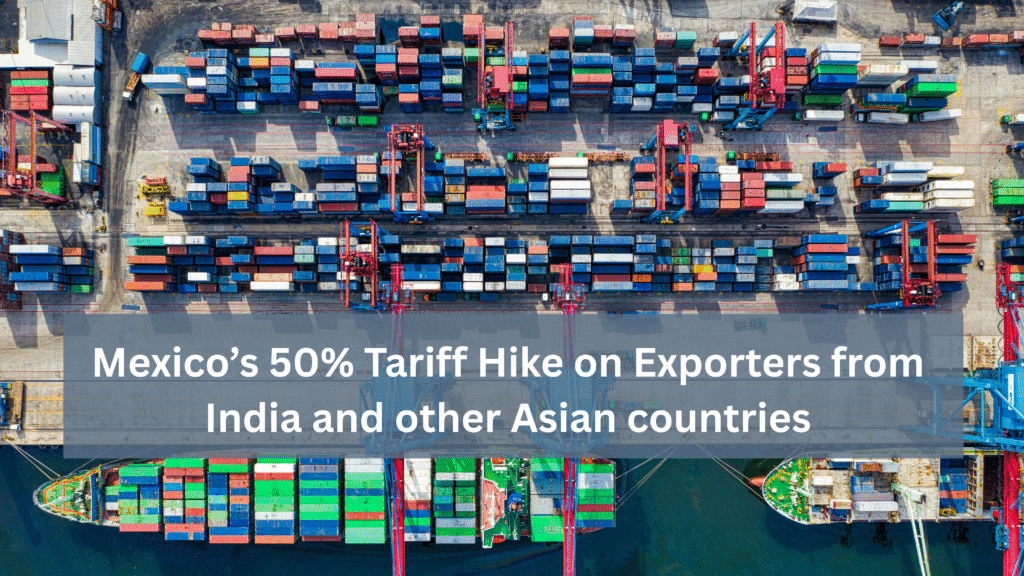
Mexico’s 50% Tariff Hike Pushes Indian and Asian Exporters to Seek FTA Amid Pressure on Steel and Auto
Mexico’s Proposed Tariff Hike Puts Indian Exporters Under Pressure
Mexico has announced plans to sharply raise import duties on goods coming from India and several other Asian countries starting in 2026, with tariffs increasing by as much as 50%. This decision is likely to affect Indian exports that currently see strong demand in Mexico, particularly passenger vehicles and automobile components, adding further pressure on exporters.
Senate Approval and Scope of Tariffs
Mexico’s Senate has approved legislation to impose import duties ranging from 5% to 50% on more than 1,400 products imported from Asian nations that do not have a trade agreement with Mexico. According to reports by the Associated Press, the bill was passed with 76 votes in favour, five against, and 35 abstentions.
The new tariff regime, scheduled to come into force from January 2026, will cover a broad range of products, including textiles, footwear, household appliances, and other manufactured goods.
Trade Strategy Behind the Move
The tariff hike comes as President Claudia Sheinbaum enters her second year in office. Her administration is working to reduce trade-related vulnerabilities, particularly those linked to the United States, Mexico’s largest trading partner. However, the increased duties on imports from Asia—especially China—add complexity to Mexico’s broader trade strategy.
Indian Exporters Seek Trade Relief
In response, several Indian exporters have approached the Commerce Ministry, urging the government to explore the possibility of a Free Trade Agreement (FTA) with Mexico to reduce the impact of the proposed tariffs. Industry representatives have also raised the issue directly with Commerce and Industry Minister Piyush Goyal.
While exporters remain hopeful about initiating early discussions, sources indicate that Mexico is currently reluctant to begin formal FTA negotiations.
Industry Concerns and EEPC India’s Stand
Pankaj Chadha, Chairman of EEPC India, stated that India should actively pursue FTA talks with Mexico to protect export competitiveness, expressing optimism that discussions could begin in the near future.
Earlier, in November, EEPC India had written to the commerce minister warning that higher tariffs could significantly weaken India’s position in key export sectors. The association recommended either an FTA or a Preferential Trade Agreement (PTA) as a possible solution.
Export Performance Shows Decline
Between April and October 2025, India’s engineering exports to Mexico declined by approximately 12% year-on-year. Several sectors saw notable drops during this period:
Steel exports fell by 7%
Iron and steel products declined by 26%
Aluminium and related products dropped sharply by 56%
Auto component exports fell by 20%
Two- and three-wheeler exports declined by 32%
Trade Value and Key Export Sectors
In FY25, India’s total exports to Mexico stood at $5.75 billion, with engineering goods accounting for $3.53 billion. Other major exports included:
Electronic goods: $544.57 million
Organic and inorganic chemicals: $400.53 million
Pharmaceuticals: $320.19 million
Ready-made garments: $190.26 million
Plastics and linoleum: $158.76 million
India also exports spices, leather products, and gems and jewellery to the Mexican market.
Bilateral Trade Overview
Bilateral trade between India and Mexico reached approximately $11.7 billion in 2024. India’s exports were largely driven by automobiles, auto components, and manufactured goods, while Mexico’s exports to India were mainly concentrated in crude oil.
Automobiles and auto components remain India’s largest export category to Mexico, followed by pharmaceuticals, engineering goods, and chemical products, according to government data.
Indian Corporate Presence in Mexico
India’s Ambassador to Mexico, Pankaj Sharma, noted that more than 250 Indian companies operate in Mexico, including firms like UPL in the fertiliser and agrochemical sector. As reported by Bloomberg, Indian investments in Mexico were valued at around $650 million last year. He also highlighted that the trade balance between the two countries has become increasingly uneven over time.