Book a Free Consultancy
How to Do Startup India Registration - Complete Guide (2026)
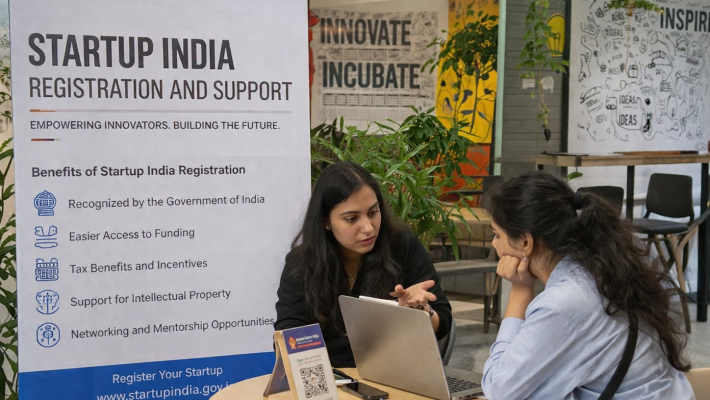
If you’re in the market to begin your own business in India, and are looking for assistance through government support, tax advantages or funding options, your first step will be to register as a Startup India business.
In this article, we will give you step by step instructions, written in plain language, that outline how Startup India works; why it is being established; the steps required to register your business; what documentation is necessary; and how you can seek funding and mentoring for your newly formed business.
The government launched the Startup India program to give Indian entrepreneurs the resources and support they need to become successful. – Prime Minister Narendra Modi. The goal of theit is to establish an infrastructure that supports innovation and allows for greater entrepreneurial growth.
Key Fact:
On January 16, 2016, version 1.0 of the Startup India Initiative was launched by the Government of India through its Department for Promotion of Industry & Internal Trade (DPIIT), which operates under the Ministry of Commerce and Industry.
Startup India’s objective has always been to increase the entrepreneurial ecosystem in India by providing tax holidays, simple compliance, and access to government tenders to all registered startups (businesses). Additionally, registered businesses are able to connect with mentors and incubators through Startup India’s network of support systems.
Who Can Register Under Startup India?
Ensure that your business is eligible before you apply for the program. The government has established several requirements that you must meet before being eligible to apply. These include the following:
• You must have a private limited company or LLP (limited liability partnership) registered with the Ministry of Corporate Affairs, India.
• The company must be less than ten years old as of the date of incorporation.
• Your annual turnover cannot exceed Rs 100 crore during any of the years you will apply for through the program.
• You must be developing or introducing new inventions, services or products that are just coming into the marketplace or making improvements to existing products, services or processes.
• The company you started cannot have been created as a result of spinning off or restructuring from an existing business.
How Startup India is Boosting Entrepreneurship in India
You might wonder – how exactly does Startup India help entrepreneurs? Here are the major ways this initiative is changing the startup game in India:
1. Tax Benefits
Registered startups enjoy a 3-year income tax holiday under Section 80IAC. This means you pay zero income tax for 3 years out of your first 10 years saving you lakhs of rupees that you can reinvest into your business.
2. Faster Exit Process
If your startup does not work out, the government allows you to wind it up within just 90 days making it easy to exit and try again without being stuck in legal hassles for years.
3. Self-Certification for Labour and Environment Laws
Startups can self-certify compliance with 9 labour laws and 3 environmental laws for the first 3 to 5 years. This reduces the regulatory burden on early-stage businesses.
4. Government Tender Access
Startup India certified companies can participate in government tenders without needing prior experience or turnover a huge advantage for new businesses looking for their first big client.
5. Funding Support
The government has set up a Fund of Funds worth Rs. 10,000 crore to invest in startups through SEBI-registered Alternative Investment Funds (AIFs).
What is Startup India Certification?
The Department for Promotion of Industry and Internal Trade (DPIIT) provides Eligible Startups with an Official Certificate known as the Startup India Certification or DPIIT Recognition.
After obtaining the certificate, you may officially declare yourself a DPIIT recognised Startup, and you will have access to various government benefits, schemes, and incentives that are available through the Start Up India program.
Important Note:
Startup India Certification is NOT the same as company registration. First you register your company (Private Limited, LLP, etc.), Then you apply for DPIIT recognition on the Startup India portal.
How to Register a New Company Under Government Startup Initiatives?
One of the biggest challenges for any new entrepreneur is finding money to grow their business. Here are the best platforms and sources to find startup funding in India:
Step 1: Incorporate Your Company
To begin, you must legally register your company. You have three different business license options available to your company’s structure. The options include:
• A Private Limited Company – This structure is the best option to raise funds if you are just starting out and plan to grow your company.
• A Limited Liability Partnership (LLP) – This is a good option for companies that provide services only.
• A Registered Partnership Firm – This structure is a simpler option but has limited advantages compared with the above two.
You can register your business through the MCA online at the Ministry of Corporate Affairs website at www.mca.gov.in. You will need to obtain:
• A Director Identification Number (DIN)
• A Digital Signature Certificate (DSC) – A Class 3 DSC is recommended for most filing purposes with the Ministry of Corporate Affairs.
• A Memorandum of Association (MOA) and Articles of Association (AOA)
• Proof of registered office address.
Step 2: Register on the Startup India Portal
After company incorporation, go to startupindia.gov.in and create your account. Click on ‘Get DPIIT Recognition’ and fill in your company details.
Step 3: Upload Required Documents
You need to upload the following documents during registration:
• Certificate of Incorporation or Registration Certificate
• PAN Card of the company
• Proof of funding (if any) – optional at this stage
• Proof of concept – pitch deck, website link, or video (optional but helpful)
• Patent or award details – if applicable
• List of awards, recognitions, or grants received
Step 4: Provide a Business Description
Write a clear description of your startup – what problem you are solving, your target customers, and how your product or service is innovative. Keep it simple and specific.
Step 5: Submit and Wait for DPIIT Approval
After submission, the DPIIT team reviews your application. Approval typically happens within 2 to 7 working days. Once approved, you get your official DPIIT Recognition Number and Certificate.
Top Platforms to Find Startup Funding in India
One of the biggest challenges for any new entrepreneur is finding money to grow their business. Here are the best platforms and sources to find startup funding in India:
Platform / Source | Type | Best For |
Startup India Seed Fund (SISFS) | Government Grant | Early-stage startups needing seed money |
iCreate Portal | Government / Incubator | Tech & innovation startups |
AngelList India | Angel Investment | Finding angel investors online |
LetsVenture | Angel / VC Platform | Connecting with VCs and angels |
Sequoia Surge | Venture Capital | High-growth potential startups |
SIDBI Fund of Funds | Government VC Fund | Startups via SEBI-registered AIFs |
Milaap / Ketto | Crowdfunding | Social impact / consumer products |
Platform / Source | Type | Best For |
Startup India Seed Fund (SISFS) | Government Grant | Early-stage startups needing seed money |
iCreate Portal | Government / Incubator | Tech & innovation startups |
AngelList India | Angel Investment | Finding angel investors online |
LetsVenture | Angel / VC Platform | Connecting with VCs and angels |
Sequoia Surge | Venture Capital | High-growth potential startups |
SIDBI Fund of Funds | Government VC Fund | Startups via SEBI-registered AIFs |
Milaap / Ketto | Crowdfunding | Social impact / consumer products |
Pro Tip: Start with the Startup India Seed Fund Scheme (SISFS) if you are in the early stage. You can get up to Rs. 20 lakh as a grant and Rs. 50 lakh as convertible debentures through approved incubators.
Expert Mentors for Tech Startup in India
Having the right mentor can save you years of trial and error. Here are the best ways to find experienced mentors for your tech startup in India:
1. Startup India Mentor Connect Platform
The official Startup India portal has a dedicated Mentor Connect feature where you can apply to connect with industry experts, investors, and successful founders who volunteer their time to guide startups.
2. iStart Portal (Government of Rajasthan)
If you are in Rajasthan, the iStart portal offers free mentoring sessions from IIT professors, serial entrepreneurs, and domain experts.
3. NASSCOM 10,000 Startups
NASSCOM’s program is especially helpful for tech and IT startups. They connect you with senior tech industry leaders and provide access to co-working spaces and investor networks.
4. TiE (The Indus Entrepreneurs)
TiE has 60+ chapters in India and connects early-stage founders with successful entrepreneurs and investors for mentoring, networking, and funding access.
5. IIT & IIM Incubators
IIT Bombay (SINE), IIT Delhi (FITT), IIM Ahmedabad (CIIE) – these incubators offer structured mentoring programs and can connect you with top faculty and alumni networks.
6. LinkedIn & X Communities
Many successful Indian founders actively mentor on LinkedIn. Join communities like iSPIRT, ProductNation, and SaaSBOOMi where CTOs and founders share knowledge and sometimes offer direct mentorship.
Frequently Asked Questions
India has produced many world-class startups. Some of the most successful and well-known include Flipkart (e-commerce), Ola (ride-hailing), Zepto (quick commerce), Zomato (food delivery), BYJU’S (edtech), Razorpay (fintech), and Freshworks (SaaS). In the tech space, fintech and SaaS startups are currently showing the highest growth rates. The ‘best’ startup depends on the industry – but all of these built their foundation with proper legal registration and government recognition.
According to research, about 90% of Indian startups fail within the first 5 years. The most common reasons are:
(1) No market need for the product – building something people don’t want,
(2) Running out of money – poor financial planning,
(3) Wrong team – lacking key skills,
(4) Poor marketing – customers don’t know the product exists,
(5) Ignoring legal and compliance requirements early on, and
(6) Scaling too fast before finding product-market fit.
The good news is that DPIIT registration gives you access to mentors and incubators who help you avoid these common mistakes.
The Startup India initiative was launched on January 16, 2016 by Prime Minister Narendra Modi. The launch event was attended by over 1,500 startups, investors, and industry leaders. Since 2016, the program has recognised over 1,30,000+ startups across India as of 2024, making India the 3rd largest startup ecosystem in the world.
For Startup India (DPIIT) registration on the portal itself, a DSC is not always mandatory since the portal allows Aadhaar OTP-based verification for individual directors. However, for company incorporation on the MCA portal (which is the step before Startup India registration), you will need a Class 3 DSC. Class 3 DSC is used for signing e-forms like SPICe+, AOA, MOA on the MCA portal. For ROC filings and compliance after incorporation, a Class 3 DSC for each director is recommended. You can get a Class 3 DSC from authorised certifying authorities like eMudhra, Sify, or NSDL.
Quick Checklist Before You Apply
Use this checklist to make sure you are ready for Startup India registration:
1. Company is incorporated (Private Limited / LLP / Partnership) on MCA portal
2. Company age is less than 10 years
3. Annual turnover is below Rs. 100 crore
4. Business involves innovation or technology
5. Certificate of Incorporation is ready
6. Company PAN card is available
7. Director DSC (Class 3) is obtained
8. Business description and pitch deck is prepared
9. Startup India portal account is created at startupindia.gov.in
Conclusion
Starting a business in India has never been easier, thanks to the Startup India initiative. From tax benefits and government funding to mentorship programs and faster compliance – the government wants you to succeed.
The key is to take action: register your company, get your DPIIT certificate, connect with the right mentors, and apply for the funding you need. Every great business started with someone who took the first step.
If you need help with Startup India registration, IEC registration, ICEGATE registration, DSC procurement, or any other compliance work – connect with our expert team. We handle the paperwork so you can focus on building your business.
Need expert assistance? xLegal Team provides end-to-end support for this, Contact us at +91 9319661668, info@xlegal.in