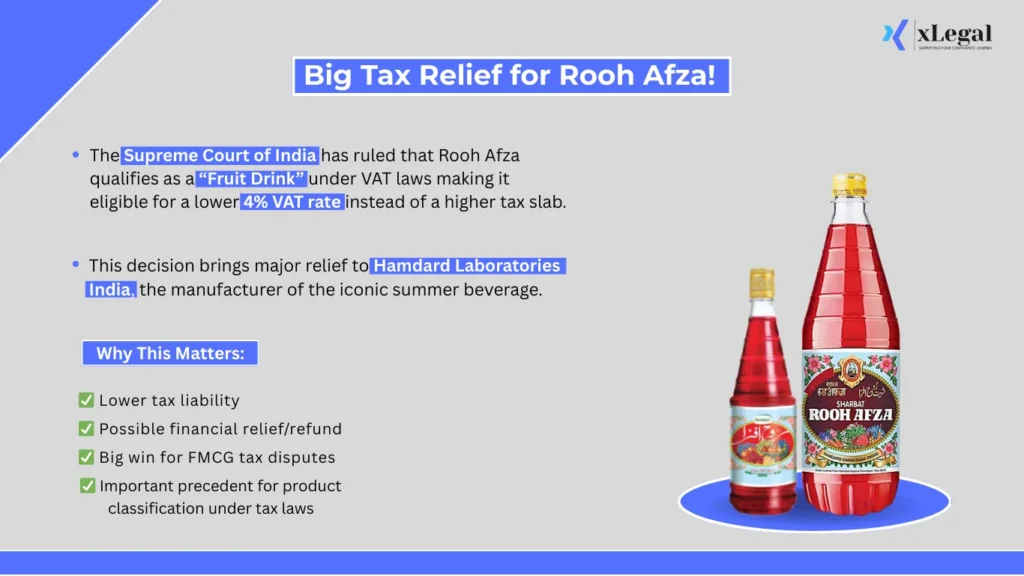
Rooh Afza Classified as Fruit Drink: Supreme Court Allows 4% VAT Rate
In a major ruling that will have far-reaching implications for the indirect tax jurisprudence landscape, the Supreme Court of India has held that Rooh Afza is a “fruit drink” under the applicable VAT laws. This means that the popular drink is liable to be taxed at a concessional rate of 4% VAT, as opposed to a higher rate of taxation.
The Supreme Court’s ruling is a major tax break for Hamdard Laboratories India, the company that markets Rooh Afza, and sets a significant precedent for disputes related to the classification of products in the FMCG industry.
Background of the Case
Disputes related to the classification of products for taxation purposes are common when products lie in a grey area between two or more different categories. In this case, the key question was:
Whether Rooh Afza was liable to be taxed as a general/higher-rate beverage, or whether Rooh Afza was a “fruit drink” eligible for concessional taxation under VAT laws.
Key Findings of the Court
During the course of interpreting the VAT structure, the Court considered the following:
The ingredients and constituents of the product
The production process
The consumer’s understanding and common parlance definition
The legislative intent underlying the concessional tax provisions
The Court finally concluded that Rooh Afza is liable to be classified as a “fruit drink” and thus liable to be taxed at the reduced rate of 4% VAT.
This ruling is in line with the established practice that taxing legislation must be interpreted strictly, and any doubts regarding classification must be cleared in accordance with the legislative intent and commercial understanding
Why This Ruling is Important
1. Relief in Tax Liability
The first and foremost effect is the significant reduction in the applicable VAT, which will ease the burden on the manufacturer.
2. Possible Relief in Taxes
Based on the progress of the case and the taxes already paid, this ruling may provide an opportunity for relief in taxes or refund of excess taxes paid.
3. Consolidation of Classification Jurisprudence
This ruling further strengthens that:
Product classification must be in accordance with the statutory interpretation
Revenue considerations cannot prevail over the legislative intent
Common trade understanding is an important factor in classification
4. Effect on FMCG Industry
This judgment may have a bearing on other cases related to drinks, syrups, concentrates, and other consumable items where tax classification plays a crucial role in determining prices and profits.
Wider Implications for Businesses
While VAT has been largely supplanted by GST, existing cases are still being decided. The implications of this judgment are extremely relevant in the GST regime, where products are still classified on the basis of tax rates.
Businesses must:
Review product classifications on a periodic basis
Keep accurate records of product composition
Review litigation risk in existing VAT cases
Take professional advice in cases of classification ambiguity
Compliance and litigation risk management are still essential in managing tax liability.
Conclusion
The Supreme Court’s holding that Rooh Afza is a “fruit drink” under VAT laws is a major milestone in the history of indirect tax litigation. While providing relief to Hamdard Laboratories India, this judgment also fortifies the legal position on disputes related to product classification.
For businesses in the FMCG and manufacturing space, this judgment is a reminder that tax classification is not just a procedural requirement but also a matter of financial prudence.
Need expert assistance? xLegal Team provides end-to-end support for this, Contact us at +91 9319661668, info@xlegal.in